July 13, 2026
11 min read
ai / developer-experience / software-architecture
What Makes a Codebase AI-Friendly?
An AI-friendly repository does not depend on a larger prompt. It depends on reproducible setup, fast feedback, concise instructions, executable boundaries, and clear task contracts.
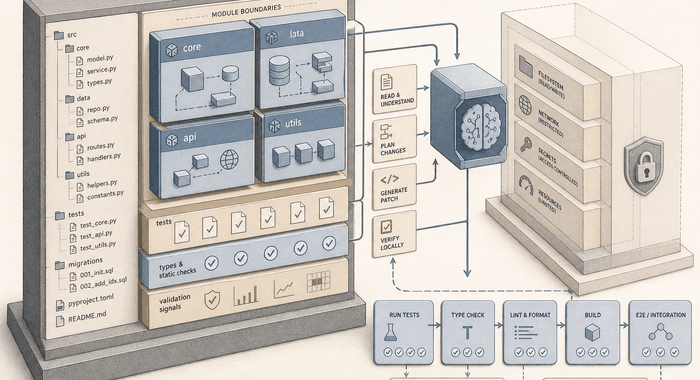
The easiest answer to "what makes a codebase AI-friendly?" is also the most incomplete one:
"Add an AGENTS.md."
I do think repository instructions matter. But the more I read and compare how coding agents actually work, the less convincing that answer becomes on its own.
A better prompt can help, but it cannot compensate for a repository that is difficult to initialize, navigate, and verify.
That is why I think the real question is not "How do I write a better prompt?" but "How do I make the repository explain itself and verify itself?"
When the problem stopped looking like a prompt problem
I started noticing this while using Codex to evolve one of my TypeScript backend projects.
The task itself was not especially complex: add a new capability, connect it to the existing data flow, and update the relevant tests. The first result looked good. The code compiled, the main path worked, and the diff was convincing enough at a glance.
But during review, I found decisions that were locally reasonable and globally wrong.
The agent had discovered a pattern that existed somewhere in the repository, but it was not the pattern that should be used in that module. It ran the most obvious validation command, but not every check required by the affected behavior. It had solved the request, but not the repository's version of the request.
My first reaction was to improve the prompt.
That worked until the next task required another piece of undocumented knowledge.
The more durable improvement was not another paragraph in the prompt. It was moving important knowledge into the repository: making the official commands obvious, documenting the few non-obvious constraints, keeping a valid implementation available as a reference, and turning important boundaries into executable checks.
That changed the interaction. I spent less time explaining how the agent should behave and more time describing the outcome I wanted. The repository started doing part of the teaching and part of the reviewing.
That was when the central idea of this article became concrete for me: the quality of an agent's work is constrained not only by the model, but by how clearly the repository exposes intent and how quickly it can reject a wrong change.
The repository is the real interface
That experience also clarified that the repository is only one part of the system around the agent, but it is the part engineering teams can deliberately shape every day.
One mental model helped me more than anything else:
The outcome of an agent task is not just a function of the model. It depends on the model, the harness around it, the tools it can call, the environment it runs in, and the codebase it is trying to modify.
The repository is not the entire interface an agent experiences. The harness, tools, execution environment, and permission model matter too.
But the repository is where much of the agent's operational reality becomes visible: how the system is initialized, where responsibilities live, which commands are official, what behavior is expected, and how a change proves that it is correct.
That changes the framing immediately.
If a repository has vague setup steps, missing validation commands, unclear boundaries, weak test coverage, and no explicit definition of done, the model is forced to improvise. Sometimes it will improvise well. Often it will produce something plausible that still violates architecture, misses an edge case, or silently breaks behavior.
An AI-friendly codebase is not a codebase that flatters the model. It is a codebase that reduces operational ambiguity.
1. Deterministic setup matters before anything else
Before an agent can improve a system, it has to initialize it.
That sounds obvious, but it is one of the most underrated parts of the conversation. If the repository depends on tribal knowledge, undocumented environment variables, hidden credentials, or a setup flow that only works on one developer's laptop, the agent starts the task in discovery mode instead of execution mode.
That is expensive and unreliable.
An AI-friendly repository makes the first steps boring:
- runtimes are pinned
- lockfiles are committed
- setup commands are documented
.env.exampleexists- migrations and seeds are reproducible
- build, test, and lint commands are predictable
This is not just good developer experience. It is agent experience too.
If a new engineer cannot clone the repository and get to a valid local state with short instructions, an agent will probably struggle for the same reason.
2. Feedback is more valuable than more instructions
Instructions tell the agent what you want. Feedback tells the agent whether it actually did it.
That distinction matters because language is soft, but validation is hard.
A sentence like "respect the architecture" is easy to write and hard to enforce. A failing test, a type error, a linter violation, or an architecture rule is a concrete signal. It lets the agent enter a useful loop:
change -> validate -> interpret failure -> correct -> validate again
This is why I increasingly think of tests, compilers, type checkers, linters, scanners, and structural rules as feedback sensors. They are not just quality gates for humans. They are the sensors that let agents self-correct before review.
There is an important nuance here: speed matters too.
A full validation suite that takes 45 minutes is rarely useful as inner-loop feedback. An AI-friendly repository gives the agent layers:
- format or lint
- typecheck
- focused tests
- module tests
- full suite
That structure gives the agent a way to validate locally before paying the cost of the largest checks.
3. AGENTS.md should route and constrain, not become a second codebase
I do not think AGENTS.md is overrated. I think it is frequently overloaded.
The best use of a repository instruction file is to capture high-signal information the agent cannot infer cheaply:
- official commands
- non-obvious directory boundaries
- unusual conventions
- required validation steps
- files that should not be edited
- restrictions around generated code, migrations, or public APIs
That is very different from turning AGENTS.md into a hand-written encyclopedia.
The evidence is still early and mixed.
One 2026 study on repository context files found that automatically generated instruction files could slightly reduce task success while increasing inference cost, while concise human-written instructions produced only modest average gains. Other reports have found improvements in execution time or token usage under different repositories and agent configurations.
The useful conclusion is not that repository instructions always help or always hurt. It is that their value depends on relevance, concision, maintenance, model behavior, and task type.
So the bar should be higher than "put everything in one file."
Good repository instructions remove ambiguity. Bad repository instructions create instruction bloat.
4. Good context is progressive, not total
One anti-pattern shows up everywhere in AI workflows: dumping everything into the initial context and hoping relevance emerges by itself.
Architecture docs. Domain rules. Historical decisions. Examples. Commands. Restrictions. Old notes. Every convention anyone can remember.
That feels helpful because it looks comprehensive. In practice, it often increases cost and dilutes attention.
The better approach is progressive context disclosure.
Give the agent a small global contract first. Then make deeper context discoverable near the work:
- local docs by module
- scoped instruction files
- reference implementations
- task plans
- ADRs
- searchable architecture maps
This is one of the strongest ideas in the entire space because it matches how good engineers already work. We do not memorize the whole repository before touching a file. We navigate toward relevance.
An AI-friendly codebase does not need to preload everything. It needs to make the right things easy to find.
5. Architecture has to be legible and, when possible, executable
Agents can generate code that works and still damages the system.
They can bypass a boundary, couple to the wrong layer, duplicate an existing abstraction, or create a new local pattern where the repository already has a standard one.
That is why architecture cannot live only in prose.
Readable structure still matters a lot:
- coherent naming
- clear module responsibilities
- explicit interfaces
- stable conventions
- examples that reflect the current code, not old intent
But the strongest architectural rules are the ones the repository can verify:
- import boundary checks
- structural tests
- schema validation
- dependency rules
- custom checks for layering or access patterns
I keep coming back to the same principle here:
If an architectural rule is important, it should not exist only in a document.
For example, an instruction file can communicate a boundary:
Controllers must not import repositories directly.That instruction is useful, but it still depends on interpretation. An executable rule can reject the violation:
{
  name: "no-controller-to-repository",
  from: { path: "controllers" },
  to: { path: "repositories" },
  severity: "error"
}
The instruction communicates intent. The automated check detects a violation. An agent-ready repository benefits from both.
The more it can be expressed as an executable constraint, the safer autonomous changes become.
6. Tasks need contracts, not vibes
A lot of agent failures are not really model failures. They are task-definition failures.
"Refactor this." "Make it scalable." "Fix the reporting module." "Improve the endpoint."
These prompts carry intent, but they do not carry enough shape.
The stronger pattern is to give the task a contract:
- current behavior
- desired behavior
- constraints
- affected area
- edge cases
- validation command
- acceptance criteria
This matters because repository-level work often breaks down after the agent understands the goal. Recent repository-level evaluation work suggests that agents can often grasp high-level intent better than they can translate that intent into the right sequence of concrete steps. That gap is exactly where plans, specs, and explicit completion signals help.
An AI-friendly repository does not just tell the agent what the system is. It tells the agent what a successful change looks like.
7. Safe autonomy needs real boundaries
An agent-ready codebase is not sufficient on its own. It also needs an agent-ready execution environment.
Once an agent can run commands, edit files, install dependencies, access the network, or use credentials, the question stops being purely about repository design.
It becomes a systems and security question.
That is why an AI-friendly repository also needs operational boundaries:
- sandboxed execution
- least-privilege credentials
- explicit approval paths for risky actions
- protected branches
- isolated environments
- reviewable diffs
- logs and traceability
This is not paranoia. It is basic control design.
Even normal repository commands can execute arbitrary code through package scripts, test hooks, build steps, and post-install flows. So the safe default is not "the repo is trustworthy because it is ours." The safe default is "execution is part of the attack surface."
The more autonomous the agent becomes, the more important these boundaries get.
A practical checklist
If I had to reduce all of this to a short review list, I would ask seven questions:
- Can a new engineer set up and validate the repository without hidden steps?
- Does the agent have fast, deterministic feedback beyond natural-language instructions?
- Are repository instructions concise, specific, and worth the tokens they cost?
- Is important context modular and discoverable instead of dumped into one place?
- Are architectural boundaries visible in the code and verified where possible?
- Do tasks define behavior, constraints, and acceptance criteria clearly enough to test?
- Can the agent operate without receiving more authority than the task actually needs?
These questions do not produce a universal maturity score. They are a practical way to locate where ambiguity, missing feedback, or excessive authority is forcing the agent to compensate.
If the answer to most of those questions is no, the model is probably not the primary problem.
What I think "AI-friendly" should really mean
I do not think the goal is to maximize how much code an agent can generate in one session.
The better goal is to maximize the probability that the agent produces a small, correct, comprehensible, and verifiable change.
That is a different optimization target.
It rewards reproducibility over improvisation, feedback over vague guidance, constraints over hope, and clarity over verbosity.
So when I think about an AI-friendly codebase now, I do not picture a giant prompt file.
I picture a repository that makes intent discoverable and correctness executable.
That, to me, is the real interface.
References
- Harness engineering: leveraging Codex in an agent-first world
- Custom instructions with AGENTS.md
- Best practices for using Copilot coding agent
- Configure the development environment for Copilot coding agent
- Feedback sensors for coding agents
- Progressive context disclosure
- Harness engineering for coding agent users
- Evaluating AGENTS.md: Are Repository-Level Context Files Helpful for Coding Agents?
- SWE-ContextBench
- RACE-bench
- Claude Code sandboxing